
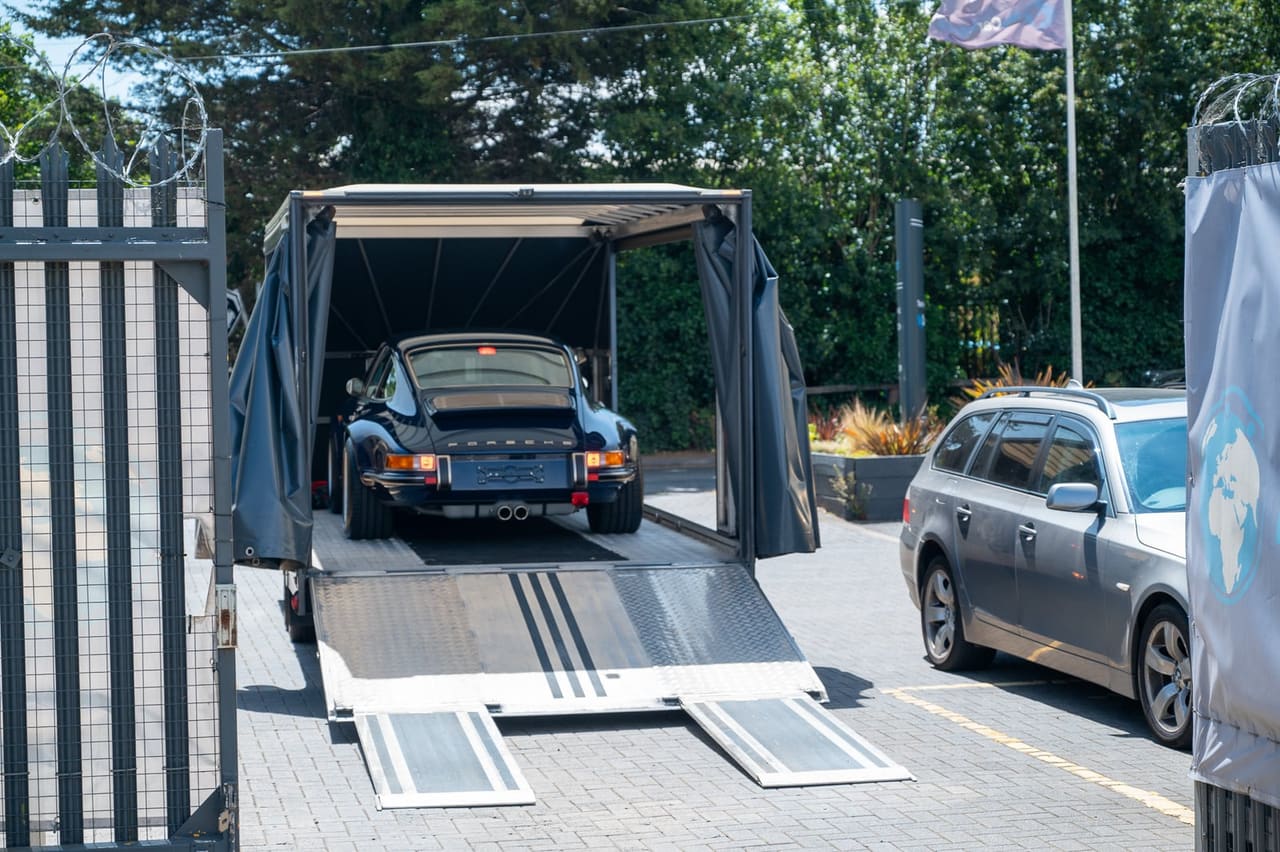
Does my classic qualify for the 5% import VAT rate?
In most cases it will, as long as the car meets all three of these conditions.
- over 30 years old
- of a type no longer in production
- substantially in its original condition, meaning the original engine, chassis, bodywork and major components, with no changes that would disqualify it as a “genuine” classic
If it meets all three, import VAT is charged at the reduced 5% rate instead of the standard 20%, and there’s no import duty to pay. That’s a substantial saving on any classic.
It’s the same for cars coming from the USA and from South Africa, and it’s a question buyers on both routes ask us a lot.
What counts as “substantially original”?
HMRC looks at the vehicle as a whole, so no single part decides it on its own. A respray, new tyres or a period-correct radio swap won’t disqualify a car.
A replacement chassis, an engine that differs from the original specification, or heavy modern modification generally will. The test is whether the car is still recognisably the model that left the factory.
Sympathetic restoration is normal on a 30-plus-year-old car and won’t count against you.
A claim is more likely to be challenged over a full rebuild that changes major components.
If you’re not sure where your car stands, send us the details before you buy or ship it, because it’s cheaper to find out early.
Does my classic need an IVA test at all?
It comes down to age. Vehicles first used before 1 January 1985 are generally exempt from Individual Vehicle Approval (IVA) altogether, because they predate the type-approval regime that IVA enforces. The DVLA registers them through the historic vehicle route instead, using dating evidence in place of a compliance test.
A vehicle built after that date may still need an IVA test unless another exemption applies, even if it clears the 30-year classic threshold for duty purposes.
So “classic for duty” and “IVA-exempt” aren’t automatically the same thing.
We confirm which category your car is in as part of the quote. Getting this wrong holds up more registrations than anything else we see.
| Question | What decides it | Typical outcome |
|---|---|---|
| 5% import VAT rate? | Over 30 years old, original condition, discontinued model | Often qualifies |
| IVA-exempt? | Built before 1 January 1985 | Usually exempt |
| Needs historic registration (no CoC)? | No Certificate of Conformity was ever issued | Common on pre-1990s imports |
| Needs standard IVA? | Post-1985, no other exemption applies | Case by case |
Dates and percentages can change, so we check them against your exact model and year before you ship.
My car has no Certificate of Conformity. Can it still be registered?
Your car can still be registered without one. It’s a route we run often, and for us it’s a normal job.
Many classics were built before a Certificate of Conformity (CoC) was ever required, particularly pre-1990s American muscle cars and older South African Land Rovers and bakkies. For those cars there’s no document to produce.
The DVLA’s historic-registration process is there for exactly this. Instead of a CoC, it relies on dating evidence (chassis and engine numbers, factory build records, marque-specialist letters, period documentation) plus a physical inspection.
It takes longer to put together than a standard application backed by a CoC.
Even so, a missing certificate is rarely a reason to walk away from an otherwise good classic.
What does a classic import cost?
Here’s what goes into the cost of a qualifying classic, on top of shipping:
| Item | Cost driver | Note |
|---|---|---|
| Import duty (none for a qualifying classic) | Nil where the vehicle qualifies | Replaces the standard 10% duty |
| Import VAT (reduced 5% rate) | Varies by value | Charged on vehicle value and shipping, instead of the standard 20% |
| Historic-registration dating evidence | Depends on evidence needed | Chassis/ |
| IVA test (where required) | Fixed per test | Skipped entirely for pre-1985 IVA-exempt vehicles |
| Modifications | Varies by origin | Lower for RHD South African classics, higher for US left-hand-drive cars |
A personalised quote is worked out from your specific model, year and condition, instead of a generic range.
What can stop a classic import claim?
These are the problems we come across most often:
- a “restoration” that swapped the chassis or engine for a non-original part, so the car fails the substantially original test
- assuming a 30-year-old car is automatically IVA-exempt when it was built after 1 January 1985 and still needs the test
- buying a car with missing dating evidence and no realistic way to get hold of it before shipping
Ready to check your classic’s eligibility?
Send us the make, model, year and condition, and we’ll confirm the duty rate, IVA status and registration route up front. Get an indicative quote and we’ll flag anything that needs attention early, so it doesn’t catch you out at customs.